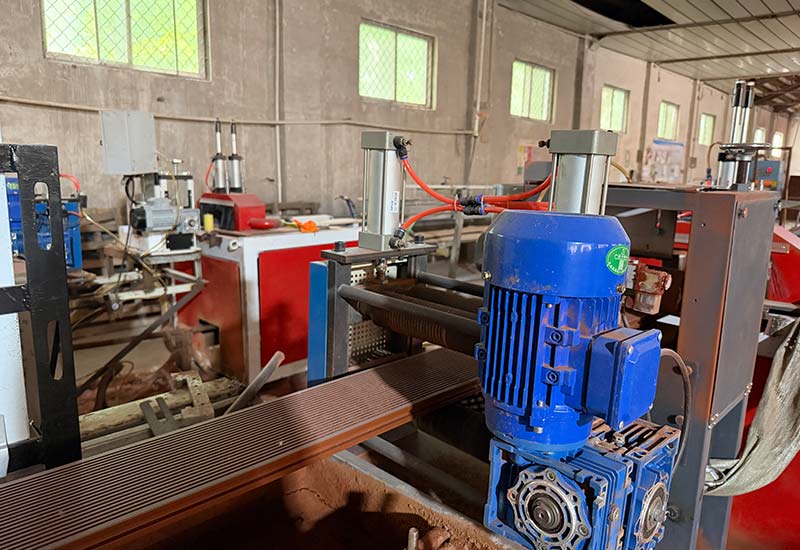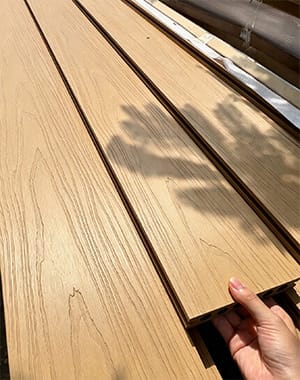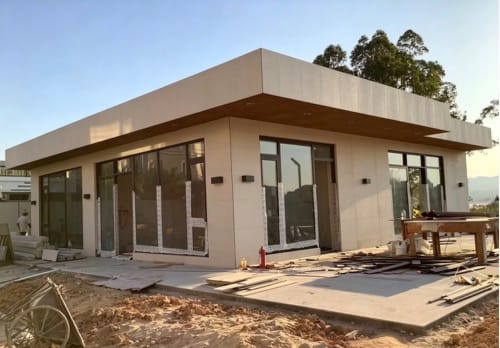
Hengyuan is a trusted WPC manufacturer focused on quality, innovation, and long-term outdoor performance. With advanced co-extrusion technology, our products offer strong waterproof, UV-resistant, and anti-corrosion durability for global applications.
Follow our latest updates and factory videos here:
👉 https://www.youtube.com/@HYWPC
Thank you for reading our blog.
Table of Contents
Introduction
Choosing WPC decking boards is not simply a matter of selecting a color or wood-grain pattern. The internal structure of the board can affect weight, handling, structural behavior, installation requirements, and how well a decking system fits a particular outdoor project.
Round-hole, square-hole, and solid profiles are all widely used in wood-plastic composite decking, but they are designed around different priorities. A residential balcony may not need the same board structure as a busy public walkway, while a garden terrace may benefit more from easier handling and installation than from maximum board mass.
For contractors, distributors, landscape designers, and project buyers, the more useful question is therefore not “Which WPC board is best?” but “Which profile is appropriate for this installation?”
Key points covered in this guide:
- How round-hole WPC decking boards are constructed
- Round-hole vs square-hole vs solid decking
- Where hollow profiles make practical sense
- When a heavier or solid profile may be preferable
- Which specifications buyers should request before ordering
- Installation factors that can influence long-term deck performance
- How to compare WPC decking products beyond appearance alone
What Are WPC Decking Boards?
WPC decking boards are extruded profiles manufactured from a combination of wood-based fibers or flour, polymer materials, and additives selected for processing and outdoor performance.
Unlike natural timber, the final profile can be engineered with different cross-sectional structures. This gives manufacturers the flexibility to produce solid boards as well as hollow boards containing round, rectangular, or square internal cavities.
That internal geometry matters because two boards with a similar surface appearance can have very different dimensions, weights, wall thicknesses, internal ribs, and intended applications.
For buyers comparing an outdoor decking system, the broader WPC Decking range should therefore be evaluated as a group of engineered profiles rather than as one uniform product.
Hollow WPC Decking
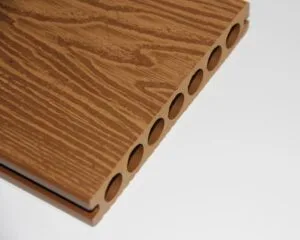
A hollow board contains internal cavities running through the length of the profile. These cavities reduce the amount of material required in the cross-section and can make the board easier to transport, handle, cut, and position during installation.
However, “hollow” does not describe one single construction. Hole shape, wall thickness, rib placement, board thickness, material formulation, and overall profile design can vary significantly.
Solid WPC Decking
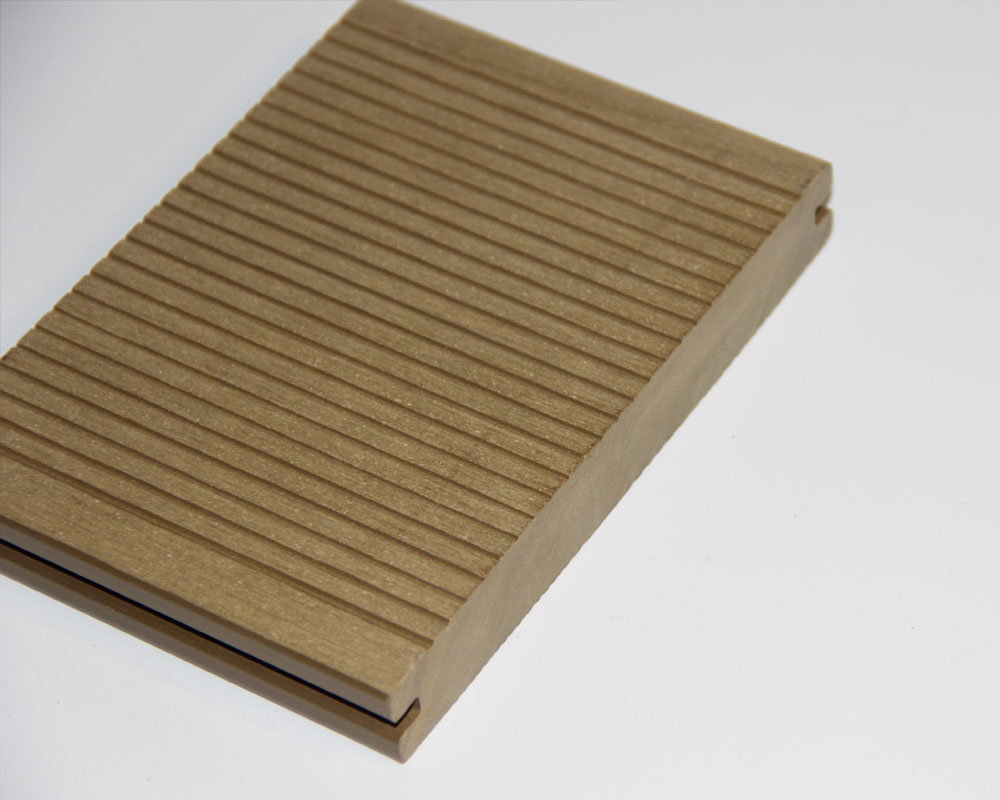
A solid profile does not contain the large continuous internal cavities found in hollow decking.
Because more material is present across its cross-section, a solid board is generally positioned toward applications where higher structural demand, concentrated loads, or more intensive traffic must be considered. Actual performance, however, should always be confirmed from the specific product data rather than assumed from the word “solid” alone.
What Is Round Hole WPC Decking?
Round hole WPC decking is a type of hollow composite decking in which longitudinal circular cavities are formed inside the board during extrusion.
The holes are part of the structural design rather than decorative features.
Hengyuan’s WPC Round Hole Floor category includes several profiles intended for different outdoor project requirements.
For example, the Hollow WPC Decking profile uses a seven-round-hole structure with a board size of 148 mm × 23 mm. Available lengths include 2.9 m, 3 m, and 4 m, with customized lengths also available.
A thicker Heavy Duty WPC Decking option uses a 140 mm × 25 mm seven-round-hole profile, providing another choice for projects requiring a more substantial board section.
This illustrates an important purchasing principle:
Round-hole decking should not be treated as one fixed performance category.
A 23 mm profile and a 25 mm heavy-duty profile may serve different project requirements even though both use round internal cavities.
Why Use Circular Cavities?
Circular cavities allow material to be removed from areas of the profile where a fully solid cross-section may not be necessary.
The surrounding walls and ribs create the working structure of the board. In practical terms, this can produce a useful balance between board weight, material use, handling, and structural performance.
It would be misleading, however, to claim that every round-hole board is automatically stronger than every square-hole board. Real performance depends on the complete cross-sectional design, material formulation, wall thickness, manufacturing quality, support spacing, and installation method.
That distinction is especially important for professional buyers.
Round Hole vs Square Hole vs Solid WPC Decking Boards
The easiest way to understand these WPC decking boards is to compare their normal project positioning rather than trying to declare one universally superior.
| Factor | Round-Hole WPC Decking | Square-Hole WPC Decking | Solid WPC Decking |
|---|---|---|---|
| Internal structure | Circular longitudinal cavities | Square or rectangular cavities | Full or near-full cross-section |
| Board weight | Generally lower than solid profiles | Generally lower than solid profiles | Usually higher |
| Handling | Easier for many installations | Relatively easy to handle | Heavier to move and position |
| Material efficiency | High | High | Lower than hollow profiles |
| Typical use | Patios, balconies, terraces, walkways | Patios, terraces, landscape decking | Higher-demand or heavier-use areas |
| Structural selection | Depends on wall and rib design | Depends on wall and rib design | Often selected where higher board mass is desired |
| Installation planning | Joist spacing and end details are important | Joist spacing and end details are important | Substructure capacity remains important |
| Best selection method | Check profile and project load | Check profile and surface system | Check load, span and total system requirements |
The important conclusion is that internal hole shape is only one selection factor.
A professional comparison should also include board dimensions, weight per meter, recommended joist spacing, surface construction, span limitations, fastening system, environmental exposure, and available test documentation.
Where Do Round Hole WPC Decking Boards Make Sense?
Round-hole profiles are especially relevant when a project requires outdoor decking with manageable board weight and efficient installation.
Residential Terraces
Terraces normally require a balance between appearance, outdoor durability, installation efficiency, and everyday pedestrian use.
A hollow round-hole profile can therefore be a practical option when the supporting structure and joist layout match the board manufacturer’s recommendations.
Balconies
Material handling can become more important on balconies because boards must often be carried through buildings, lifts, stairs, or restricted access areas.
The lower mass associated with hollow WPC decking can make installation logistics easier than working with heavier profiles.
Garden Paths and Courtyards
Garden pathways and courtyard decks frequently involve detailed layouts, edge cuts, landscaping features, and relatively small working areas.
Hengyuan positions its 148 × 23 mm Hollow WPC Decking for applications including garden pathways, balconies, terraces, and smaller outdoor areas.
Higher-Traffic Outdoor Areas
Higher traffic does not necessarily mean that hollow decking must be excluded.
Instead, buyers should examine a heavier-duty profile and the complete support system. Hengyuan’s 140 × 25 mm Heavy Duty WPC Decking provides an example of how the same round-hole concept can be adapted through a thicker cross-section.
For particularly demanding applications, buyers can also compare a Standard WPC Solid Decking profile rather than making a decision based only on hollow-board appearance.
Round Hole or Square Hole: Which Should You Choose?
This is one of the most common questions when buyers can physically see the different cross-sections.
There is no reliable answer based solely on whether the cavities are circular or square.
Start With the Project
Consider what will actually happen on the deck.
A private balcony, hotel terrace, poolside walkway, garden path, restaurant terrace, and heavily used public landscape area may expose WPC decking boards to very different traffic levels and loading patterns.
The profile should be selected around those conditions.
Compare the Complete Cross-Section
Ask for a dimensional drawing or clear cross-section.
Look at:
- Overall board width
- Overall thickness
- Number of cavities
- Cavity dimensions
- Outer wall thickness
- Internal rib thickness
- Board weight per meter
- Surface thickness if capped
- Recommended support spacing
Two products described as “hollow WPC decking” can be substantially different once these measurements are compared.
Examine the Surface System
The internal profile is only one part of outdoor performance.
Buyers should also distinguish between traditional composite surfaces, embossed surfaces, and capped or co-extruded surfaces.
For projects where surface exposure is a major concern, a product such as Hengyuan’s Square Hole WPC Decking can be compared with traditional round-hole products not only by internal geometry but also by its co-extrusion surface design.
What Specifications Should Buyers Check?

One of the biggest mistakes in WPC procurement is comparing products using only dimensions and color.
A more professional RFQ should request enough information to understand how the board is expected to perform as part of a complete decking system.
Board Dimensions
Width and thickness are basic specifications but should never be considered alone.
A 25 mm hollow board and a 20 mm solid board cannot be meaningfully compared simply by deciding that the thicker product must be stronger.
Cross-section, formulation, density, support spacing, and profile engineering also matter.
Weight per Meter
Weight per meter gives buyers another useful comparison point.
It helps estimate container loading, site handling requirements and, together with a cross-sectional drawing, can provide a clearer picture of how much material is present in the profile.
Recommended Joist Spacing
Ask the manufacturer for the recommended spacing between supports for the exact board being purchased.
Do not copy the joist spacing used for another WPC profile just because both products have similar external dimensions.
Mechanical Performance
For projects with defined engineering or regulatory requirements, request relevant performance information rather than relying only on catalog descriptions.
In the United States, ASTM D7032 provides procedures for establishing performance ratings for wood-plastic composite and plastic lumber used for exterior deck boards, stair treads, guards, and handrails.
Which reports or standards are required will depend on the destination market, application, and local project requirements.
Surface and Weathering Requirements
Outdoor WPC decking is continuously exposed to sunlight, temperature changes, moisture, dirt, and foot traffic.
The surface technology, pigments, additives, embossing, and any protective cap layer should therefore be evaluated alongside the internal profile.
For projects with particularly demanding sun exposure, another option worth comparing is UV Resistant WPC Decking, depending on the required profile and specification.
How Installation Affects Hollow WPC Decking Performance
Even a well-designed WPC decking board can perform poorly if the supporting system or installation details are unsuitable.
For round-hole WPC decking, several details deserve particular attention.
Support the Board Correctly
Deck boards work together with the joists beneath them.
The manufacturer’s recommended joist spacing should therefore be treated as part of the product specification rather than as an optional installation suggestion.
Reducing structural support to save installation material can create problems that are incorrectly blamed on the decking itself.
Plan for Drainage
Outdoor decking should not trap standing water beneath the deck system.
The substrate, joists, board layout, surrounding landscape, and drainage direction should be planned as one system.
Allow for Thermal Movement
WPC contains polymer components, so installers need to consider dimensional movement caused by temperature changes.
End gaps, side spacing, board length, fastening method, and installation temperature should follow the manufacturer’s instructions for the selected product.
There is no single expansion gap that should automatically be copied to every WPC decking board.
Use Compatible Clips and Fasteners
Hidden fastening systems help produce clean deck surfaces, but clips also control spacing and board movement.
The clips, screws, joists, starter fasteners, and decking profile should therefore be treated as a coordinated system.
Five Mistakes to Avoid When Buying WPC Decking Boards
1. Comparing Only Price Per Board
A lower board price does not necessarily mean a lower installed project cost.
Board width, usable coverage, required joist spacing, accessories, shipping volume, breakage allowance, and installation labor all affect the final result.
2. Assuming More Holes Means Better Performance
The number of cavities does not provide enough information to judge a WPC decking profile.
Hole diameter, wall thickness, ribs, board thickness, formulation, and support spacing must be considered together.
3. Choosing Hollow or Solid Without Considering Traffic
Residential terraces and busy public spaces create different design requirements.
The decking profile should follow the expected use rather than a generic assumption that hollow is “good” or solid is “better.”
4. Ignoring the Substructure
WPC decking boards are only the visible part of a decking system.
Joists, support spacing, drainage, ventilation, fastening and perimeter details have a major influence on installation quality.
5. Ordering Without a Physical Sample
Colors and embossed wood grain can appear different on screens, catalogs, and actual outdoor installations.
For larger projects, evaluating a physical sample, cross-section, surface texture, and color under real lighting conditions can reduce specification errors.
A Practical WPC Decking Selection Checklist
Before sending an RFQ to a WPC decking supplier, buyers can use the following checklist.
| Information to Request | Why It Matters |
| Cross-sectional drawing | Shows the actual internal structure |
| Width × thickness | Confirms basic profile size |
| Weight per meter | Helps compare profile construction and logistics |
| Available lengths | Affects cutting waste and transport |
| Hollow, round-hole, square-hole or solid | Identifies profile family |
| Surface treatment | Influences appearance and surface performance |
| Capped or uncapped structure | Important for product comparison |
| Recommended joist spacing | Critical for system design |
| Installation guide | Reduces site errors |
| Clip and accessory system | Confirms installation compatibility |
| Available colors | Supports design selection |
| Relevant test reports | Supports technical evaluation |
| Packaging method | Important for international transport |
| Customization options | Useful for project-specific requirements |
This type of information makes supplier comparisons much more meaningful than asking only for a catalog and quotation.
How Hengyuan’s WPC Decking Range Fits Different Projects

One advantage of using a broader WPC decking range is that buyers do not need to force one profile into every application.
For general terraces, balconies, and landscape applications, the WPC Round Hole Floor range provides several hollow-profile options.
The 148 × 23 mm Hollow WPC Decking uses seven round cavities and a 3D wood-grain embossed surface, making it relevant where manageable weight and adaptable outdoor use are priorities.
Where a more substantial round-hole profile is required, the 140 × 25 mm Heavy Duty WPC Decking provides a thicker alternative.
Projects comparing a different hollow geometry can evaluate Square Hole WPC Decking, while applications requiring a solid cross-section can consider Standard WPC Solid Decking.
This profile-based approach makes it easier for contractors, distributors, and project buyers to match the decking system to the actual installation instead of selecting one product for every project.
Conclusion
Round-hole WPC decking is not simply a lightweight alternative to solid composite decking. It is a distinct profile design that can provide an effective balance of material efficiency, handling convenience, outdoor performance, and installation flexibility.
At the same time, buyers should avoid deciding between round-hole, square-hole, and solid WPC decking boards based on cavity shape alone.
The better selection process considers the complete system:
project use, expected traffic, board dimensions, cross-section, weight, support spacing, surface technology, fastening method, drainage, environmental exposure, and relevant performance information.
For residential terraces, balconies, gardens, pathways, landscape projects, and many general outdoor applications, a properly selected round-hole WPC decking system can be a highly practical solution. For heavier-use areas, thicker round-hole or solid profiles can then be evaluated according to the specific project requirements.
FAQ
Is round hole WPC decking better than square hole decking?
Not automatically. Hole geometry is only one part of the board design. Wall thickness, internal ribs, overall dimensions, material formulation, surface construction, support spacing, and manufacturing quality should also be compared.
Are hollow WPC decking boards strong enough for outdoor use?
Hollow WPC decking boards are commonly designed for outdoor applications such as terraces, balconies, garden paths, patios, and walkways. Their suitability for a particular project should be confirmed using the manufacturer’s load, span, joist-spacing, and installation recommendations.
Is solid WPC decking always better than hollow decking?
No. Solid decking may be appropriate where higher structural demand or heavier use is expected, but it is also heavier. Hollow profiles can be more practical where easier handling, efficient material use, and standard pedestrian applications are priorities.
What is the difference between standard and heavy-duty round-hole WPC decking?
The distinction normally comes from profile design, dimensions, wall and rib geometry, and intended application. In Hengyuan’s current range, for example, the standard Hollow WPC Decking is 148 × 23 mm, while the Heavy Duty WPC Decking uses a thicker 140 × 25 mm profile.
Does the number of holes determine WPC decking strength?
No. Hole count alone is not enough to judge structural performance. Buyers should examine the complete cross-section and request appropriate technical information from the manufacturer.
What should I ask a WPC decking supplier before ordering?
Request board dimensions, cross-section drawings, weight per meter, recommended joist spacing, available lengths, surface treatment, fastening system, installation instructions, color samples, packaging details, customization capabilities, and relevant test documentation.
Which WPC decking board is suitable for a balcony?
A hollow profile can be a practical choice for many balconies because lower board mass can make handling easier. However, the existing balcony structure, support spacing, drainage, expected loads, local regulations, and manufacturer recommendations should all be checked before final selection.
Can round-hole WPC decking be used for commercial projects?
It can be used in suitable commercial applications when the selected profile and substructure satisfy the project’s loading, traffic, installation, and regulatory requirements. Higher-traffic projects may justify comparing thicker heavy-duty round-hole profiles with solid WPC decking before specifying the final system.