Table of Contents
Key Takeaways
- A WPC Great Wall Panel uses raised ribs and recessed grooves to introduce texture, shadow and a sense of height to a wall.
- Exterior suitability depends on the specific material, surface construction and installation system, not simply the panel’s appearance.
- Profile proportions, color, joint alignment and lighting work together to shape the finished design.
- Low maintenance still includes cleaning and inspection, while correct support, movement allowances and drainage remain essential.
Planning a facade, courtyard feature wall or outdoor hospitality project? Share your wall dimensions, project location and preferred finish with Hengyuan WPC to discuss suitable profiles, samples and installation information before placing an order.
Why Vertical Lines Change the Feel of a Space
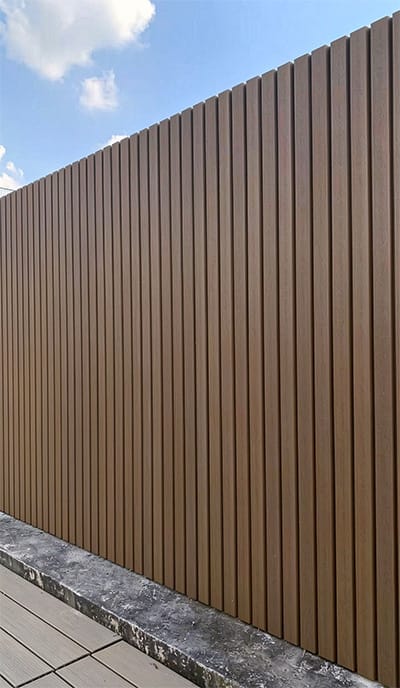
A courtyard can have attractive paving, comfortable seating and carefully chosen plants yet still feel enclosed by a plain boundary wall. Often, the missing detail is a surface that gives the eye somewhere to travel.
Vertical wall panels introduce that direction. Their repeated lines draw attention toward the top of a wall, doorway or entrance canopy, helping the composition feel taller and more ordered. The effect is visual: the dimensions stay the same, but the way the space is read can change.
A WPC Great Wall Panel adds depth to this arrangement. Instead of presenting one uninterrupted plane, its ribs and grooves create a sequence of highlights and shadows. That makes it useful where a wall needs to contribute more to the design without relying on a complicated pattern.
A Surface That Changes With the Light
In direct sunlight, the raised sections catch the light while the recesses appear darker. Under softer daylight, the same profile looks more restrained. After sunset, carefully positioned lighting can bring the texture forward again.
For an entrance wall or restaurant terrace, this offers two different moods from the same material: a clearly defined surface during the day and a more intimate backdrop in the evening.
Repetition That Connects the Architecture
Vertical lines work especially well when they relate to nearby door frames, window mullions or columns. Rather than treating the cladding as an isolated decorative patch, align it with these existing elements. A few well-positioned panels can give an entrance more presence without covering the entire building.
What Is a WPC Great Wall Panel?
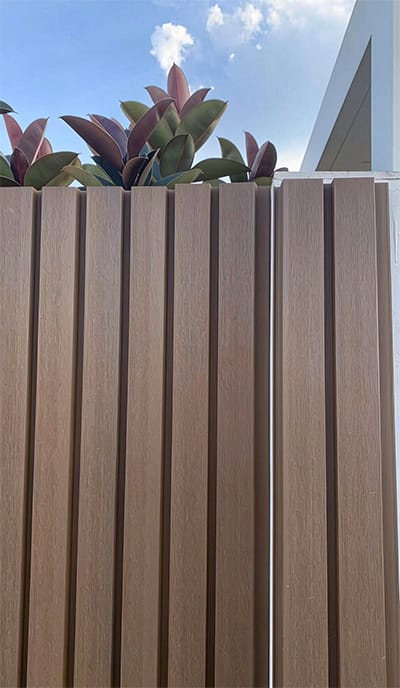
A WPC Great Wall Panel is a decorative wood-plastic composite profile with repeated raised and recessed sections. The term describes its stepped cross-section, which is associated with the outline of the Great Wall. Depending on the supplier and profile shape, related products may be described as fluted panels, ribbed cladding or slatted wall panels.
These names overlap, but they are not a single performance standard. A slatted appearance does not, by itself, identify the material or confirm that a product is suitable for outdoor exposure.
Understanding the Composite Material
Extruded WPC profiles combine wood flour or fibers with a thermoplastic polymer and formulation additives. The polymer may be polyethylene, polypropylene or PVC, depending on the product. The USDA Forest Products Laboratory’s overview of wood thermoplastic composites explains this distinction.
For buyers, the practical question is which formulation and construction are used in the selected model. Two panels with similar wood-grain finishes may have different substrates, surface layers and installation requirements.
Distinguishing Interior Panels From Exterior Cladding
Fluted decorative panels are available in several materials, including WPC, timber, aluminum and other polymers. Some are intended for indoor decoration, while others are designed for exterior wall systems.
Start with a clearly identified exterior product when planning an exposed wall. Hengyuan’s WPC cladding range provides a starting point for comparing available profiles, dimensions and finishes. Confirm the intended application of the exact model before specifying it.
What Matters for Outdoor WPC Performance?
A convincing wood appearance matters at the sample stage. Once the panels are installed, sunlight, rain, temperature changes and the supporting structure become equally important. Evaluate these conditions alongside the visual design.
Co-Extrusion and Surface Protection
Co-extruded profiles use a distinct surface layer formed together with the core. In suitable formulations, this layer can help improve resistance to weathering and staining. Its performance depends on the surface material, coverage and manufacturing quality.
Hengyuan lists co-extruded construction for the three profiles compared later in this guide. Ask for the relevant product specification and available test information when evaluating a model for an exposed location.
UV resistance should not be interpreted as a promise that a color will never change. USDA research on weathering of wood-plastic composites identifies sunlight, water and processing conditions as factors affecting appearance and performance. Compare weathering information for the proposed product rather than relying on a broad material label.
Moisture Resistance and Wall Protection
Moisture resistance is useful for exterior finishes, but it does not make the complete wall waterproof. Rain can reach joints, edges, penetrations and the space behind the cladding. The underlying wall assembly must manage that water.
Likewise, the presence of plastic does not guarantee freedom from surface mold, movement or damage. Suitable product selection, drainage and routine cleaning all contribute to the condition of an outdoor installation.
Low Maintenance in Everyday Use
A factory-finished WPC surface can reduce the need for periodic painting or staining associated with some timber finishes. That is a useful benefit for commercial properties, rental accommodation and courtyards where access for maintenance may be inconvenient.
Cleaning and occasional inspection are still part of ownership. Choose a product whose care instructions fit the location and the way the property will be managed.
Fluted WPC Panels Compared With Other Wall Finishes
The best wall finish depends on the design brief. Fluted profiles suit projects that need visible depth and repetition, while flatter surfaces can provide a quieter background. Use the comparison below to narrow the visual direction before reviewing individual product specifications.
| Wall finish | Typical visual effect | What to review before selection |
|---|---|---|
| Fluted WPC panels | Repeated ribs, defined shadows and a strong linear rhythm | Rib spacing, groove depth, exterior suitability, joints and corner details |
| Flat WPC cladding | A calmer surface with emphasis on board layout and finish | Board orientation, visible seams, surface texture and fixing method |
| Timber slats | Natural grain variation and individually expressed strips | Timber species, treatment, movement, finish and maintenance plan |
| Aluminum slats or panels | Precise profiles with coated, metallic or wood-look finishes | Coating specification, connections, movement allowances and exposure conditions |
A fluted surface can also be paired with a flat one. For example, a textured entrance surround against a plain facade creates a focal point while keeping the overall elevation simple.
Where Vertical WPC Wall Panels Work Well
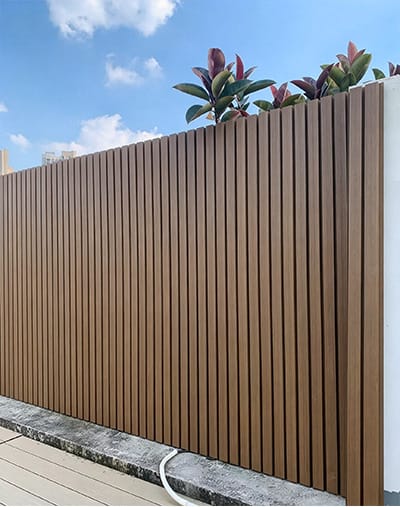
Building Facades and Entrance Features
Vertical cladding can frame a front door, define a reception entrance or break up a broad elevation. Wood-inspired tones introduce warmth beside glazing, painted walls or stone, while deeper colors can give an entrance a more pronounced outline.
Plan the panel layout around openings from the beginning. A balanced arrangement at the door jambs and corners usually looks more deliberate than a layout that finishes with narrow, awkward cuts.
Courtyard Feature Walls and Garden Backdrops
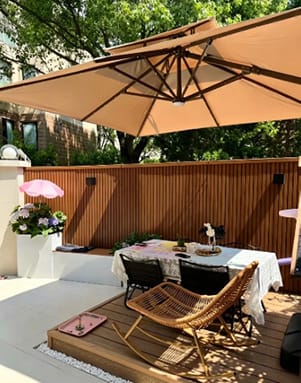
In a courtyard, a fluted wall can form a backdrop for planting, seating or an outdoor dining area. The repeated pattern gives the composition structure, while foliage softens its geometry.
Keep soil, irrigation and drainage details in mind. Planters should not create persistent wet contact with the panels or obstruct required clearances. Where the installation forms a freestanding partition, provide a suitable supporting structure; decorative cladding is not a substitute for an engineered wall or fence system.
Cafe Terraces, Hotels and Outdoor Dining Areas
A textured backdrop can make a seating area feel intentionally designed, especially when it connects with the furniture, signage and lighting. Consider using the panels behind a bench, around a service entrance or along one side of a terrace.
For hospitality projects, think about daily operation as well as photographs. Position waste bins, movable furniture and cooking equipment so they do not expose the surface to avoidable impact, staining or unsuitable heat.
Covered Corridors, Soffits and Eaves
Linear profiles can continue a wall design into a sheltered overhead area, creating a visual connection between an entrance and its canopy. On a ceiling, the direction of the lines can emphasize the length of a passage or lead the eye toward a destination.
Review the wall and ceiling cladding collection for possible options. Overhead use requires confirmation that both the selected panel and its fixing arrangement are suitable for that application.
How to Choose the Right Profile, Color and Layout
Match the Texture to the Scale of the Wall
A close, fine rhythm can suit an entrance viewed at short range. A more pronounced profile can remain visually distinct across a larger courtyard or facade. Neither is automatically better; the choice depends on viewing distance and the role of the wall.
Review several panels joined together rather than relying on a small cut sample. This makes it easier to assess the repeating pattern and the appearance of the seams.
Compare Colors in the Actual Lighting
A wood-look finish can appear warmer in sunlight and more muted in shade. Nearby paving, glass and painted surfaces also affect how the color is perceived.
Compare physical samples beside the materials already selected for the project. For an outdoor dining space, assess them under the proposed evening lighting as well. A color that works in a showroom may create a different impression on site.
Design the Corners and End Conditions Early
The main wall area is only part of the finished appearance. External corners, window returns, top edges and the junction with paving are often the places people notice most closely.
Decide how these edges will be finished before calculating quantities. Coordinate trims, reveals and movement joints with the panel pattern, and consider how an individual damaged panel could be accessed for replacement.
Test the Lighting With a Small Mock-Up
Lighting directed across the surface reveals the profile more strongly than evenly distributed frontal light. It can also reveal uneven joints and imperfect alignment.
A small mock-up with the proposed light fitting helps the design team assess shadow depth, glare and spacing before committing to the complete installation. Include a joint and an edge detail so the test reflects the finished wall.
WPC Great Wall Panel Profiles to Compare
Hengyuan’s published product range includes the following ripple profiles. They offer useful starting points for comparing panel proportions; final selection should consider the complete cross-section, installation method and intended exposure.
| Product | Listed profile size | Listed lengths | Listed construction |
|---|---|---|---|
| Ripple WPC Wall and Ceiling Cladding 160mm | 160 × 21 mm | 3 m, 4 m or customized | WPC co-extrusion with ripple surface |
| Heavy Duty WPC Wall Cladding 214 × 31 | 214 × 31 mm | 3 m, 4 m or customized | WPC co-extrusion with ripple surface |
| 219mm Ripple WPC Cladding | 219 × 26 mm | 3 m, 4 m or customized | WPC co-extrusion with ripple surface |
The listed profile width is not necessarily the effective installed cover width. Request the current section drawing and coverage information before preparing a quantity estimate. Confirm available lengths, colors and customization for the order.
What to Confirm Before a Bulk Order
Alongside the approved finish sample, agree on the details that affect procurement and installation:
- The exact profile, material construction and intended application.
- Effective cover width, supplied lengths and dimensional tolerances.
- Compatible subframe, clips, screws, trims and other required components.
- Support spacing, movement allowances and installation guidance.
- Available test reports relevant to the project, including fire performance where required.
- Color acceptance, packing requirements, quantities and the delivery schedule.
For phased projects, discuss batch consistency and replacement stock at the outset. These details can be difficult to resolve after the first elevation has been installed.
Installation Details That Keep Vertical Lines Straight
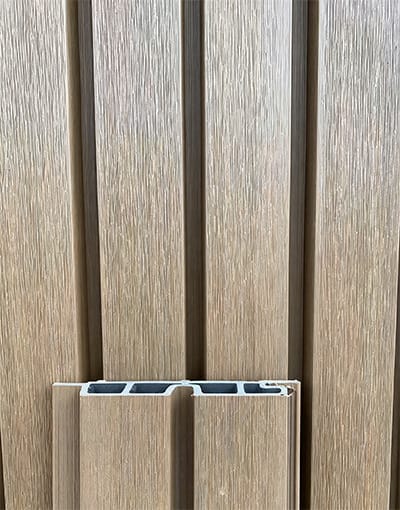
The appeal of a vertical wall depends on consistent alignment. Small changes in spacing, frame position or joint width can interrupt a repeated pattern, especially when light falls across it.
The following points support installation planning. The exact fixing arrangement and dimensions should come from the selected product’s installation details and the project design.
Prepare a Suitable, Aligned Subframe
Check that the supporting surface and subframe are suitable for the installation. Establish a level reference and a plumb starting line before fixing the first panel.
Set out the frame to suit the profile’s permitted spans, fixing positions and orientation. Avoid pulling a panel against an uneven support simply to force its face into alignment.
Plan the Panel Layout Before Cutting
Mark the main joints, openings and edge conditions on the elevation. Where possible, position cuts so the pattern remains balanced at both ends of the wall.
Check the first few panels as a group, then continue checking alignment as work progresses. Correcting an early deviation is easier than adjusting a completed run.
Allow for Movement
WPC profiles respond to temperature changes, and their movement must be accommodated by the fixing and joint design. End gaps and other allowances depend on factors such as material, board length and installation conditions.
Follow the specified details for the chosen system. Do not assume one gap dimension suits every profile, or fill a movement joint merely to make the surface appear seamless.
Maintain Drainage Behind the Cladding
A building facade needs a planned route for water that reaches behind the outer finish. The Whole Building Design Guide’s explanation of wall cladding and rain-screen construction describes the roles of the water-resistive barrier, drainage space and flashing.
Coordinate these layers at openings, corners and the top of the wall. Where vertical panels use horizontal supports, the supporting arrangement must preserve the designed drainage path. Sealant belongs only where the system details require it; drainage and ventilation openings must remain functional.
Check Fixings and Finishing Details
Use the specified compatible fasteners and accessories, with exposure conditions considered when selecting metal components. Confirm the details for corners, cut ends and transitions to other materials.
Before handover, inspect the wall from several viewing positions and under its installed lighting. Look for inconsistent joints, damaged surfaces, loose components and blocked drainage paths while access is still convenient.
How to Care for Outdoor WPC Wall Cladding
Routine care helps the surface retain a clean, consistent appearance. Follow the selected product’s cleaning instructions and choose methods that protect its finish.
Remove loose dust, leaves and other debris before they build up in grooves or around the base of the wall. Where permitted by the care guidance, use water, a mild cleaner and a soft brush or cloth. Rinse away residue and test an unfamiliar cleaning product on a discreet area first.
Avoid assuming that aggressive solvents, abrasive tools or pressure washing are suitable for every WPC surface. Check the manufacturer’s instructions before using them.
Include fixings, trims and drainage openings in periodic inspections, particularly after severe weather or nearby building work. Addressing a loose accessory or an obstructed outlet early is simpler than repairing the resulting damage.
Frequently Asked Questions
Is a WPC Great Wall Panel the Same as a Fluted Wall Panel?
The terms often describe a similar ribbed appearance, but they do not identify identical products. A WPC Great Wall Panel is made from a wood-plastic composite, while fluted panels may use timber, aluminum or other materials. Check the substrate, surface construction and intended use before treating two profiles as equivalent.
Can WPC Great Wall Panels Be Used Outdoors?
Yes, when the selected model is designed for the proposed exterior application. An indoor decorative panel should not be assumed suitable for sun and rain. Confirm the material specification, available weathering information, fixing system and project requirements before using the panels on an exposed wall or facade.
Are WPC Wall Panels Completely Waterproof?
Moisture-resistant cladding does not make the complete wall assembly waterproof. Water can reach joints, edges and the space behind the panels. Exterior installations therefore need suitable wall protection, drainage, flashing and clearances, with details coordinated for the chosen cladding system and building.
Do WPC Great Wall Panels Need Painting or Regular Maintenance?
Many factory-finished WPC panels do not require routine repainting or staining, but they still need care. Remove accumulated dirt, follow the approved cleaning method and inspect trims, fixings and drainage openings periodically. Any coating, repair or intensive cleaning should follow the selected product’s instructions.
Can These Panels Be Installed on Ceilings or Soffits?
Only when the specific panel and fixing system are suitable for overhead installation. A product intended for a vertical wall should not automatically be used on a ceiling. Confirm support spacing, fastening, movement allowances and any project requirements before specifying a soffit or canopy lining.
What Information Helps With Product Selection and Ordering?
Provide the project location, application, wall dimensions, preferred color, profile style and estimated quantity. Drawings, photographs and the planned installation direction help clarify the design. Include the required delivery timing and any technical requirements so the proposed product and accessories can be reviewed together.
Plan Your Vertical Wall Design With Hengyuan WPC
The strength of a fluted wall lies in the relationship between its lines: their spacing, depth, alignment and response to light. When those details are resolved, the surface can bring warmth and definition to a facade, courtyard or outdoor gathering space.
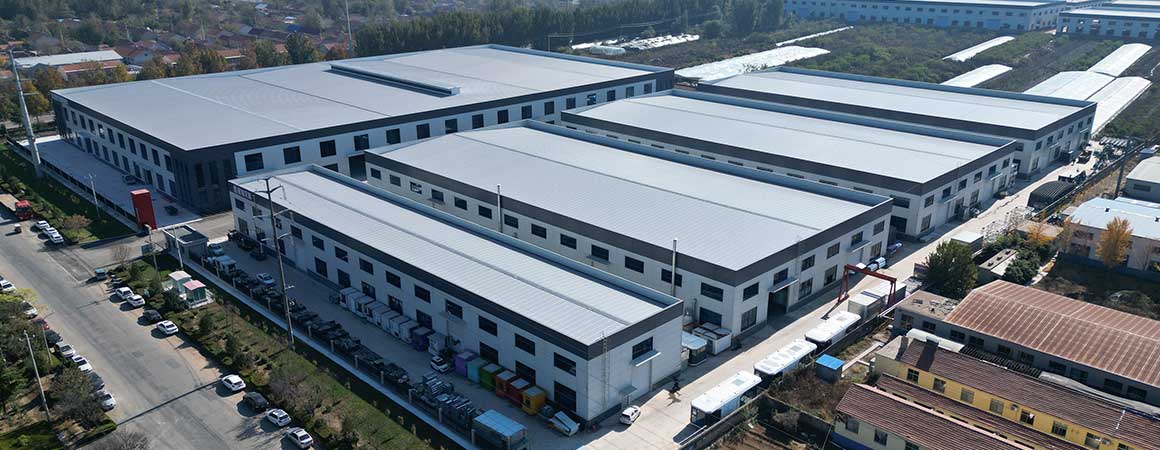
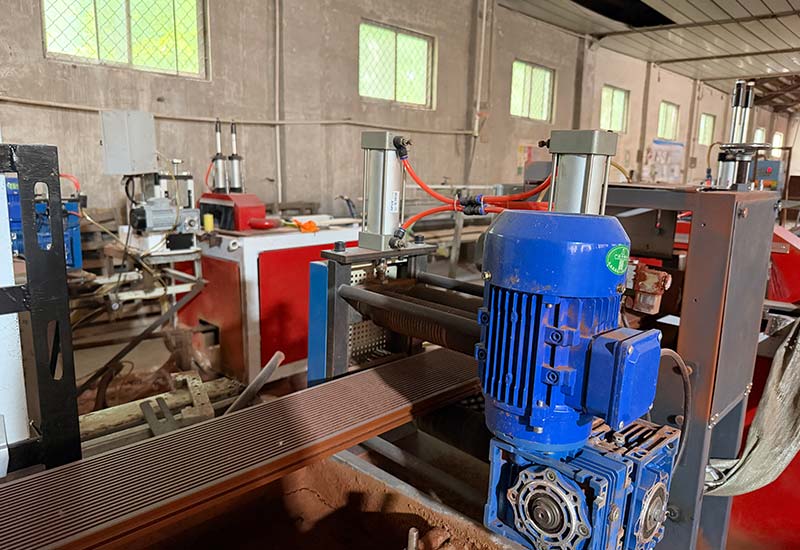
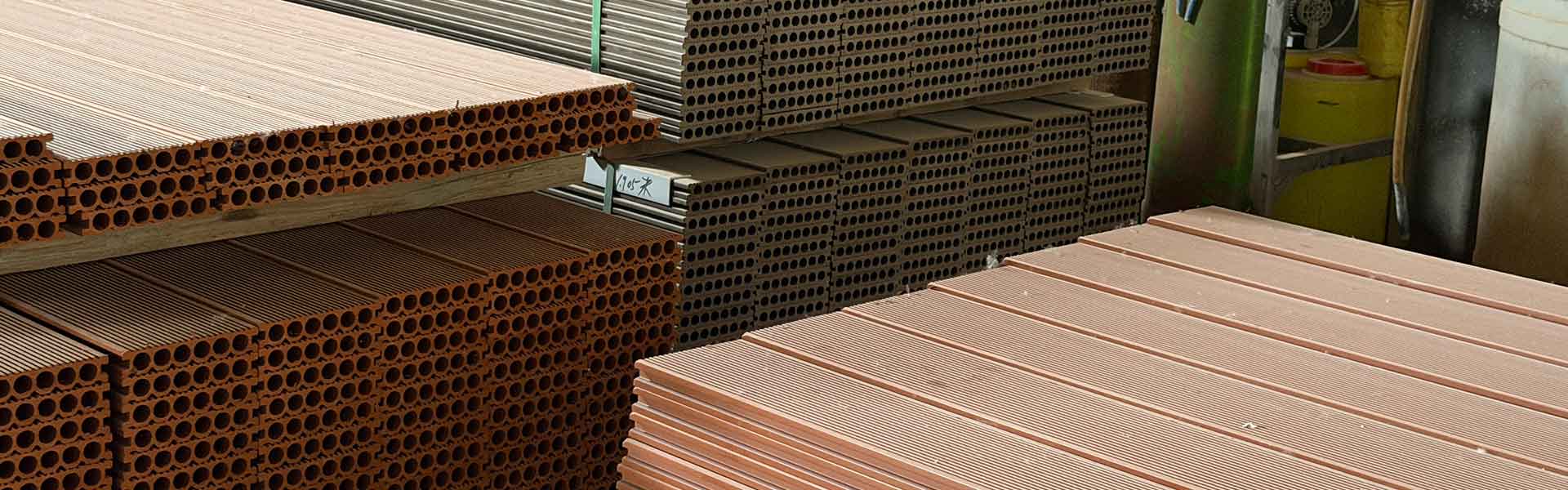
Hengyuan’s WPC manufacturing and project support covers profile production, extrusion and co-extrusion options, finish selection and installation guidance. Available customization depends on the selected profile and confirmed production requirements.
To begin, contact Hengyuan WPC with your drawings or project details. Share the application, dimensions, preferred finish and expected quantity to discuss suitable profiles and confirm the next steps for samples and supply.